
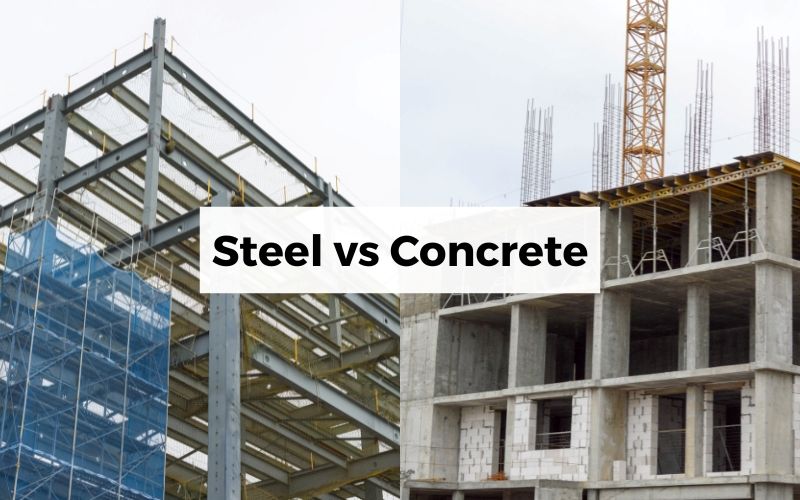
For many people, concrete remains the top safe choice when building residential houses, while steel frame is only suitable for factories, warehouses, and production plants. However, nowadays, more and more investors and homeowners are switching to steel for residential, industrial, and commercial projects. So, between steel and concrete buildings, which one is the better choice?
WHAT IS STEEL FRAME?
Steel frame is the main load-bearing structural system of a building, consisting of multiple steel components connected together (usually carbon steel, alloy steel, or high-strength steel). This system helps withstand loads effectively and distributes weight evenly across the entire frame, thereby ensuring the stability and solidity of the structure.
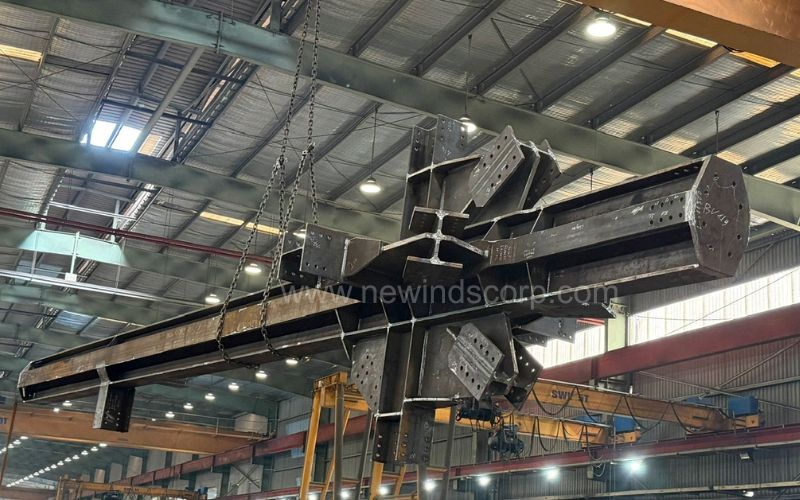
CONSTRUCTION PROCESS OF STEEL FRAME BUILDINGS
Step 1: Design and Fabrication at the Factory
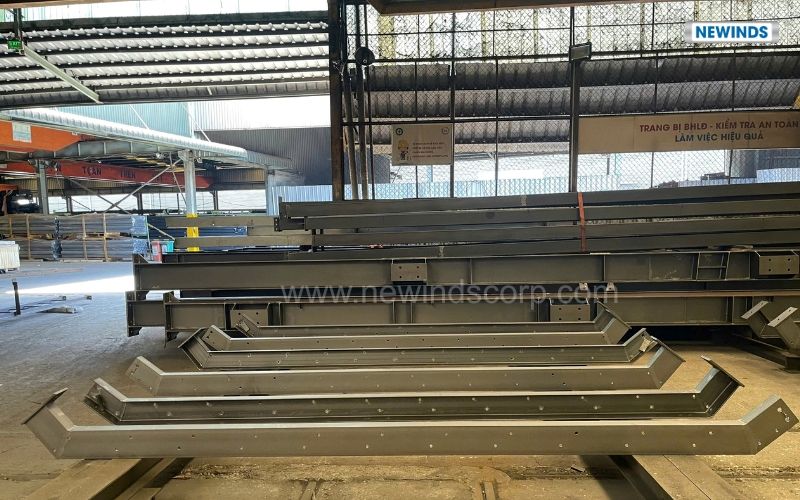
After the drawings are approved, the information is sent to the factory for production, which includes:
- Cutting steel to precise dimensions
- Drilling holes, welding connections, and creating joint plates
- Applying anti-rust coating, including primer and finish paint, or hot-dip galvanizing for projects in coastal or harsh environments.
Step 2: Foundation Construction
Excavating and pouring the concrete foundation. The foundation for steel buildings does not need to be overly large or deep because the structure is lighter than concrete buildings. Anchor bolts are then installed to secure the steel columns.
Step 3: Frame Erection and Finishing
The process involves erecting horizontal beams, roof trusses, bracing systems, and purlins to form the building’s main frame. Finally, roofing sheets, wall panels, doors, and other equipment are installed to complete the project.
The average time for erecting the main frame is 1–4 weeks, depending on the project scale.
Suitable Project Types
- Factories and manufacturing plants
- Warehouses, cold storage, supermarkets, and commercial centers
- Prefabricated residential houses
- Exhibition halls, trade fairs, stadiums, and aircraft hangars
- Farms, steel sheds, and barns
WHAT ARE CONCRETE BUILDINGS?
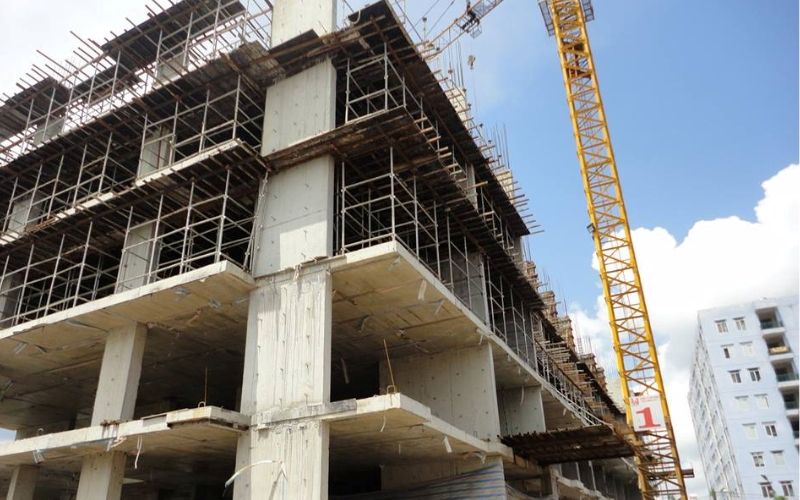
Concrete buildings are structures constructed using reinforced concrete to form the main load-bearing frame.
CONSTRUCTION PROCESS OF CONCRETE BUILDINGS
Step 1: Geological Survey & Foundation Construction
Conduct a geological survey and prepare the site. Excavate the foundation, with depths typically ranging from 1.5–3 meters or deeper depending on soil conditions. Piles may be driven if the soil is weak.
Step 2: Formwork and Concrete Pouring
Use wooden planks, steel formwork, or composite materials to create square or round molds according to the design dimensions. The formwork must be tight with proper gaps to prevent water loss from the cement during pouring.
Concrete is mixed on-site and poured continuously until it reaches the designed level.
Step 3: Concrete Curing
To allow the concrete to harden, it must be continuously watered for 7 days to prevent cracking and covered with plastic sheeting. Concrete typically takes about 28 days to reach maximum strength.
Step 4: Formwork Removal and Inspection
Once the required strength is achieved, the formwork is removed for quality inspection, checking dimensions, flatness, and surface cracks.
Suitable Project Types
- Low-rise residential houses
- Apartments requiring long-term durability
- Buildings needing good sound and thermal insulation: hospitals, schools, hotels
- Chemical plants and warehouses storing flammable goods
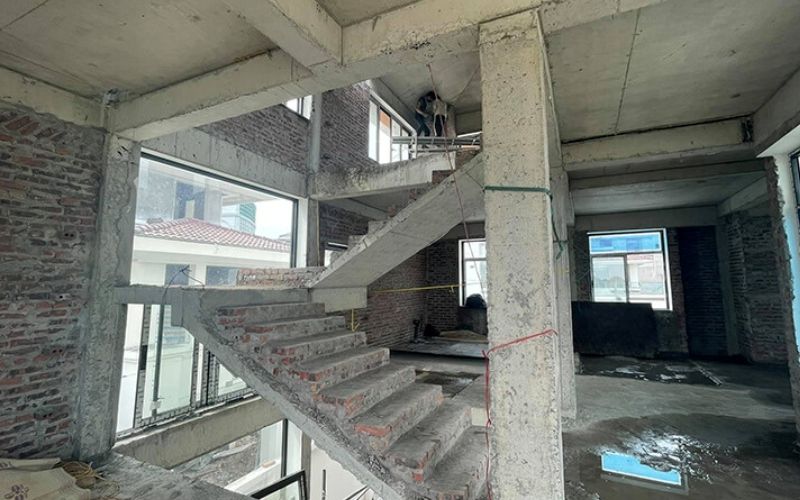
COMPARISON BETWEEN STEEL FRAME AND CONCRETE BUILDINGS
Whether steel or concrete is the optimal choice for your project depends heavily on many factors. One type may be better for certain projects and vice versa. These factors include:
Design Flexibility
First, you need to consider which material best suits your project’s design. Choose concrete if the project has a traditional style and no need for future design changes.
Conversely, choose steel if you want a modern, creative architectural design and the possibility to change the building’s function later.
Construction Time
Steel: Steel frame buildings consist of 2 main phases.
Fabrication of steel components at the factory (done in parallel with foundation work): Average fabrication time is 2–6 weeks for projects from 500m² to under 2,000m².
Frame erection on-site: Erection is quite fast because the components are pre-fabricated. The main frame erection takes 7–14 days for projects from 500m²–1,500m². For high-rise buildings and large factories (1,500–5,000m²), erection time can take up to 4–6 weeks.
Overall, the total construction time for steel frame buildings averages 6–8 weeks for small to medium-scale projects.
Concrete: Total construction time for concrete buildings is usually 50%–70% longer than steel, mainly due to the waiting time for concrete to cure (7–28 days) and greater susceptibility to weather conditions.
- Single-story house (<150m²): 3–5 months
- 2-story townhouse (200–300m²): 5–8 months
- 3-story townhouse (300–500m²): 7–11 months
Construction Cost
Overall, steel frame often offers better cost efficiency thanks to lighter foundations, faster construction time, reduced labor costs, and less material waste (as steel can be recycled).
However, concrete buildings can be more cost-effective in the long term because they require no rust protection maintenance and offer better energy savings.
Durability and Load-Bearing Capacity
This is probably the most important criterion you should carefully evaluate when choosing between steel and concrete.
Steel has the best strength-to-weight ratio among construction materials, allowing it to bear large loads while remaining safe. Its excellent elasticity is a major advantage, enabling it to flex and support creative designs, making it highly suitable for earthquake-resistant structures.
Many factories, warehouses, and logistics centers choose steel frame due to its ability to span large distances, allowing easy storage of large quantities of goods and unobstructed movement of machinery.
Reinforced concrete performs very well under compression, especially vertical loads. Concrete buildings also offer better fire resistance and are less prone to corrosion than steel.
DISADVANTAGES OF STEEL AND CONCRETE BUILDINGS
Both steel and concrete have their own strengths and weaknesses. After comparing the differences between these two materials, you should also understand the disadvantages of each to determine whether they will significantly impact your project and find suitable mitigation solutions.
Disadvantages of Steel Frame
- Susceptible to corrosion and rust
This is the biggest drawback you need to consider. In normal, stable climates, a good anti-rust coating is sufficient. However, in coastal or high-humidity areas, galvanizing the steel frame is recommended to minimize corrosion.
- Poor fire resistance
Steel loses strength quickly under prolonged high temperatures (above 500°C). It is best to apply fire-resistant coatings or use specialized fire protection methods.
- Prone to vibration
Because the steel frame is lightweight and highly elastic, it can vibrate more under strong winds. Therefore, a well-designed bracing system is essential during erection to reduce vibration.
Disadvantages of Concrete Buildings
- Long construction time
The construction process involves many steps, with waiting periods for concrete curing (7–28 days) significantly extending the total timeline and increasing labor costs.
- Higher initial foundation costs
Foundation work is more complex and requires more materials due to the heavy load. On poor soil, extensive ground improvement is needed, further increasing time and cost.
- Difficult to modify after completion
For complex designs, drawings must be finalized perfectly because once concrete is poured, changes are nearly impossible without demolition.
There is no single definitive answer to whether steel frame or concrete building is better. The better choice depends on clearly defining your project’s purpose, design requirements, long-term cost savings, and future expansion needs.
If you are still undecided between building a steel or a concrete building, please contact the experts at Newinds. We will provide the most optimal construction solution for your project.
Contact Newinds:
Email: sales@newindscorp.com
Phone/Whatsapp/Zalo: Ann Yen +84 344 644 077