
Steel formwork acts as a mold system that protects and shapes concrete during the pouring and curing process. So how is steel formwork structured to perform this role effectively? To answer this question, it is first necessary to understand how the steel formwork fabrication process takes place.
UNDERSTANDING STEEL FORMWORK
Steel formwork is a system of steel molds or steel panels used to shape structural components such as columns, beams, slabs, walls, and foundations in many construction projects.
Thanks to its ability to withstand much higher load pressure compared to timber formwork, steel formwork helps:
- Limit deformation
- Reduce the risk of bulging and cracking
- Ensure construction safety
Main Components
To create a solid structure, steel formwork generally includes the following components:
- Face plate: High-quality steel plates with an average thickness of about 3–6 mm.
- Load-bearing frame: Mainly fabricated from box steel, U-shaped steel, angle steel, or structural steel sections to withstand high loads.
- Bracing and supports: A system of horizontal, vertical, and standing braces that keep the formwork stable.
- Bolts, clamps, ties: Accessories used to firmly connect the panels together while allowing easy assembly and disassembly when needed.
- Other necessary accessories: Depending on the application, additional components such as adjustable props, connecting corners, and anti-warp stiffeners may be used.
WHAT ARE THE TYPES OF STEEL FORMWORK?
Steel formwork is customized to suit practical construction needs. Some common types used today include:
- Steel panel formwork: With standard dimensions (1200 × 600 mm) and easy assembly for walls, slabs, and columns, this is currently the most widely used type.
- Steel modular formwork: A highly modular system that can be easily adjusted and optimized for projects with repetitive structures such as high-rise buildings.
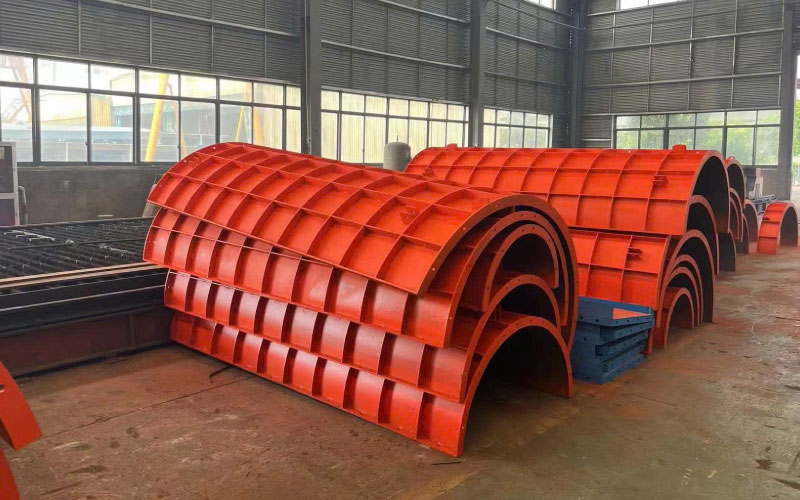
- Steel tunnel formwork: A casting system that includes both walls and slabs to form a monolithic box structure. Therefore, this type is ideal for projects requiring fast construction progress.
- Steel column/beam formwork: Specifically designed for columns and beams that must withstand high loads.
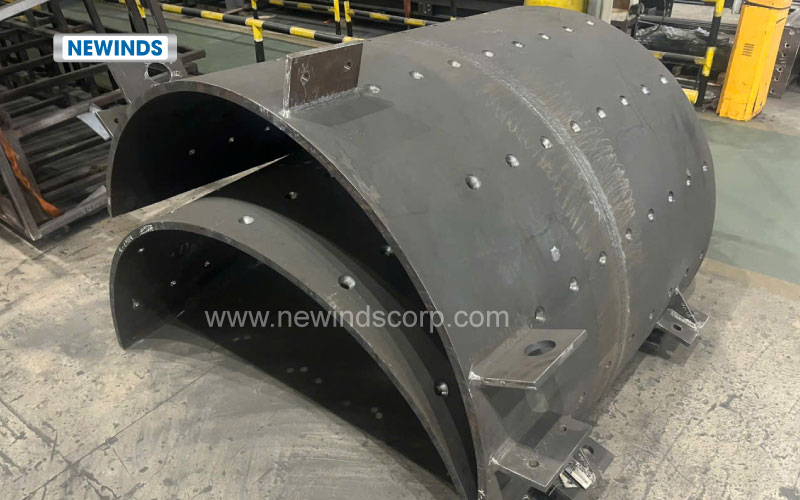
- Custom steel formwork: Suitable for fabricating complex structures such as curved or bent shapes.
HOW DOES STEEL FORMWORK WORK?
Basically, steel formwork functions as a temporary mold that keeps the concrete inside fixed in shape and position until it reaches the required strength.
To understand how steel formwork works, it is important to look at the process from assembly to removal, which includes the following steps:
- Assemble the panel sections together to form a complete formwork system based on the technical drawings.
- Use bracing systems and horizontal and vertical supports to secure the formwork and prevent expansion or cracking when concrete is poured.
- Apply a release agent to the steel surface to prevent damage to the concrete surface during formwork removal.
- Pour concrete into the formwork and compact it properly until it hardens (usually 1–3 days), then remove the formwork, clean it, and reuse it for the next cycle.
STEEL FORMWORK FABRICATION PROCESS
The steel formwork fabrication process requires high precision and strict control because any deviation may lead to errors during installation. This requirement becomes even more important when producing custom steel formwork, where each panel or component must match unique project specifications and structural dimensions.
To ensure efficiency and safety during use, steel formwork should be fabricated according to the following standard process:
- Design and 3D modeling: When designing formwork, engineers must calculate concrete load, wind force, and maximum deflection to ensure that the structure does not crack or deform during concrete pouring.
- Steel cutting: Most steel formwork fabricators today use laser cutting or CNC plasma cutting technology to cut steel plates or structural steel according to technical drawings.
- Frame welding: Box steel, U-shaped steel, and angle steel are welded into frames using automatic MIG/MAG welding machines or TIG welding. Welds must be uniform and free from welding defects.
- Panel assembly: The steel face plates are connected to the frame to form a complete structure, followed by surface grinding and slag removal.
- Surface treatment: Although this is the final step in steel formwork fabrication, it greatly determines the durability of the formwork. A reliable steel formwork fabricator will carefully apply appropriate surface protection methods to improve corrosion resistance and extend the service life of the formwork system.
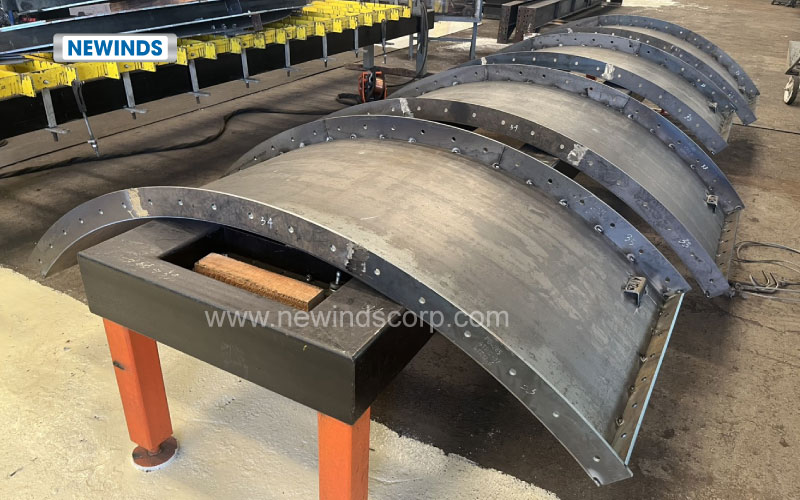
Common surface treatment methods include:
- High-pressure sandblasting for surface cleaning
- Steel shot blasting
- Two-layer anti-rust epoxy coating or powder coating
- Hot-dip galvanizing if the formwork is used in coastal or high-humidity environments
WHERE IS STEEL FORMWORK USED?
Steel formwork is widely used in many types of construction projects, including:
- High-rise buildings and apartments (where walls, slabs, and columns are repetitive).
- Bridges, roads, bridge piers, and tunnels.
- Industrial steel buildings and large warehouses.
- Water tanks, retaining walls, and complex foundations.
- Projects requiring smooth concrete surfaces with minimal plastering (such as hotels and shopping centers).
- Architecturally complex projects that require custom steel formwork, such as curved structures, irregular shapes, or special concrete elements.
ADVANTAGES OF STEEL FORMWORK COMPARED TO TIMBER FORMWORK
| Criteria | Steel Formwork | Timber Formwork |
| Durability | Can be reused up to 200–500 times with proper maintenance. Galvanized formwork can withstand harsh environments. | Typically used only 5–20 times because wood easily rots or warps, affecting the concrete inside. |
| Load capacity | Can withstand high concrete pressure without deformation, making it suitable for large structures. | Can only handle moderate loads and may crack under excessive concrete pressure. |
| Concrete surface finish | Smooth surface with fewer voids. | Uneven surface, usually requiring additional plastering. |
| Initial cost | Higher cost but longer service life. | Lower initial cost. |
| Environmental impact | Lower impact because it can be reused and recycled. | Consumes natural wood, contributing to deforestation. |
| Main disadvantages | High initial investment cost. | Short lifespan and poor concrete surface quality; not suitable for large projects. |
NEW TRENDS IN STEEL FORMWORK FABRICATION
As technology is increasingly applied in all aspects of life, it is also becoming essential in the mechanical fabrication industry. To improve quality and enhance environmental sustainability, several new trends are being applied in steel formwork fabrication:
- BIM integration and digitalization: 3D design and automated laser/CNC cutting help reduce waste, increase precision, and minimize fabrication errors.
- Hybrid materials: Combining steel with aluminum or composite plastics to make the formwork lighter and easier to move.
- Greater sustainability: Many steel formwork fabricators are gradually shifting to recycled steel to reduce waste and move toward zero-waste production.
- CNC machining and automation: Manual fabrication methods are increasingly being replaced by automation such as CNC cutting machines, automatic plasma cutting, and welding robots to increase mass production speed and minimize welding defects.
Although many new technologies are applied in steel formwork fabrication, the key factor in ensuring the best quality still lies in choosing a reputable fabrication company. Therefore, it is important to select an experienced and reliable steel formwork fabricator that has previously fabricated steel formwork. Take the time to carefully research and evaluate potential suppliers to avoid issues in later stages of the project.
If you need a high-quality steel formwork fabricator offering tailored metal solutions that meet international standards.
Contact Newinds:
Email: sales@newindscorp.com
Phone/Whatsapp/Zalo: Ann Yen +84 868 482 038